
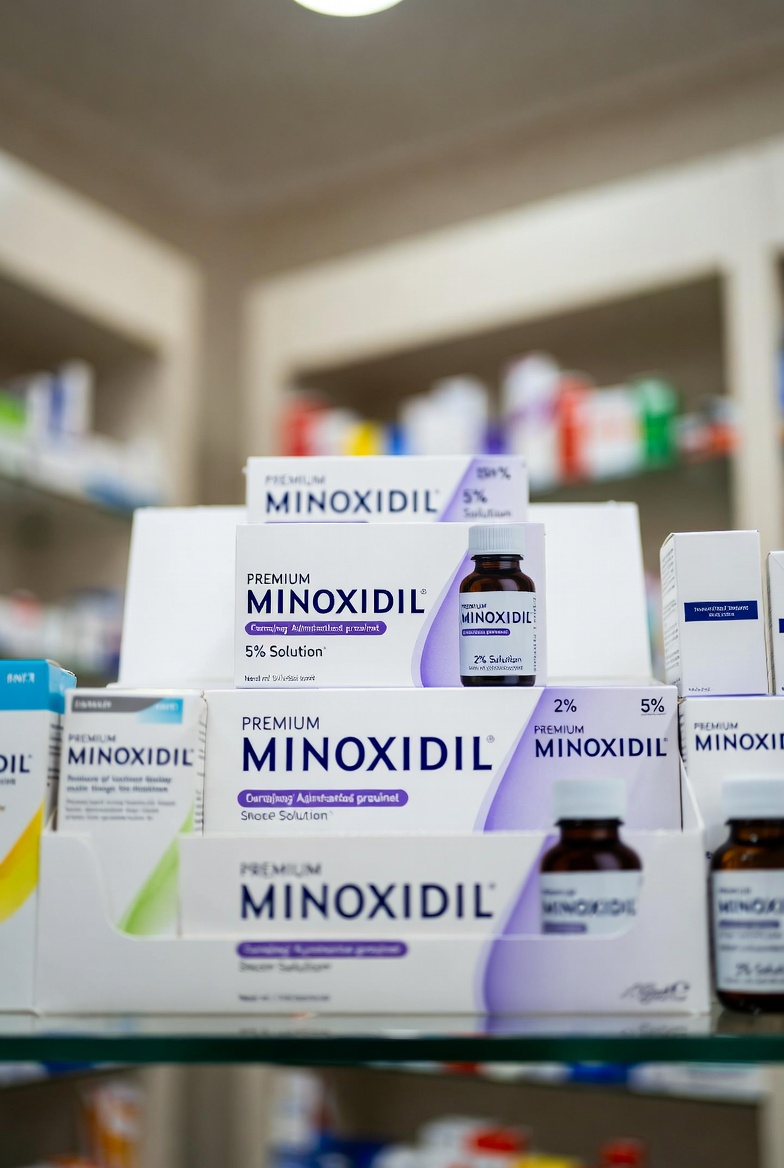



Minoxidil Topical
Topical solution or foam · Hair regrowth treatment
Minoxidil is a topical scalp treatment used to help regrow hair and slow inherited hair loss. This page explains what it is actually good for, how to apply it correctly, what results to expect, and the practical mistakes that most often keep people from getting a fair trial of treatment.
See price at checkout
- Topical scalp use only. Do not apply to other parts of the body.
- Most benefit comes from consistent use over months, not days or weeks.
- It is not a reliable fix for a receding frontal hairline.
- Exact directions differ by product label, strength, and whether the product is marketed for men or women.
Key facts about Minoxidil
- Minoxidil is used to stimulate hair growth and slow inherited hair loss on the scalp.
- It works best as a consistency treatment, not a quick-change treatment.
- Stopping treatment usually means the benefit fades and the newly maintained or regrown hair is gradually lost.
- Not everyone responds, and the amount of regrowth varies from person to person.
How ordering Minoxidil works
- Choose the labeled form and strength that fits your treatment plan.
- We help confirm how the product should be applied and whether your pattern of hair loss is the kind minoxidil is actually meant for.
- Choose available pickup or delivery options for your ZIP at checkout.
Important safety information
Do not use if
- Your hair loss is sudden, patchy, unexplained, or associated with scalp pain or inflammation.
- Your scalp is red, irritated, infected, sunburned, or otherwise unhealthy at the application site.
- You plan to use it on the front hairline expecting reliable temple regrowth.
Common side effects
Common problems include scalp dryness, itching, flaking, irritation, or changes in hair texture. Some users also notice unwanted facial hair growth if the product spreads beyond the scalp.
Stop and get medical advice for
Chest pain, rapid heartbeat, dizziness, faintness, swelling in the hands or feet, sudden unexplained weight gain, severe scalp irritation, or persistent unwanted hair growth outside the treatment area.
This page is informational and does not replace advice from your clinician or pharmacist.
What is Minoxidil?
Minoxidil is a topical hair regrowth treatment applied directly to the scalp. It is used to help stimulate hair growth and slow inherited thinning, especially on the top of the scalp rather than along the frontal hairline.
What Minoxidil is used for
Minoxidil is used for scalp hair loss patterns that fit inherited thinning rather than sudden or unexplained shedding.
- Gradual thinning on the crown or top of the scalp
- Pattern hair loss in men
- Pattern thinning in women when a women-labeled product is chosen and used as directed
- Long-term maintenance of benefit with continued application
It is not the right self-treatment for patchy hair loss, sudden shedding, or scalp disease, and it is not considered a dependable treatment for frontal recession at the temples.
How it is used
Apply minoxidil directly to the scalp, not to the hair. Exact instructions depend on the labeled product, so the carton matters. More product does not make it work faster, and using it more often mainly increases the chance of irritation or side effects.
| Product type | Typical labeled use |
|---|---|
| Men’s 5% solution | 1 mL applied to the scalp twice daily |
| Men’s 5% foam | Half a capful applied to the scalp twice daily |
| Women’s 5% foam | Commonly labeled for once-daily scalp use |
Results may begin as early as 2 to 3 months in some users, but many people need 4 months or longer before they can judge the response fairly. Some labels for women advise allowing even longer before deciding it is not helping.
Warnings and interactions
- External use only: Never swallow it and never apply it to areas other than the scalp.
- Wrong pattern of hair loss: Do not use it as a self-treatment if your hair loss is sudden, patchy, unexplained, or not clearly patterned.
- Heart history: Ask a doctor before use if you have heart disease.
- Scalp condition: Do not apply to an irritated, inflamed, infected, or painful scalp.
- Eye contact: If it gets into the eyes, rinse with plenty of cool water.
- Women, pregnancy, and breastfeeding: Use only the product appropriate for you, and avoid use during pregnancy or breastfeeding unless a clinician specifically advises otherwise.
- Flammability: Some foam and solution products are flammable, so avoid fire, flame, or smoking during and immediately after application.
Missed dose guidance
If you miss a dose, just continue with the next scheduled application. Do not double up, and do not try to “catch up” with extra product later.
Storage
Store at room temperature, tightly closed, away from excess heat and open flame, and out of reach of children.
Practical pharmacist guidance
The most common reason people think minoxidil “failed” is not that the medicine is weak, but that the application never really reaches the scalp consistently. With longer hair especially, a surprising amount of product gets trapped in the hair shaft and dries there instead of reaching the follicles. The fix is not to use more; it is to part the hair deliberately and treat the skin in rows. Foam users miss another detail all the time: warm fingers melt the foam too fast, so the product spreads like styling mousse instead of sitting where you need it. Cold fingers or a cold surface make application much more precise. Another point most people judge incorrectly is timing. Early in treatment, some shedding can increase briefly, and that often scares people into stopping just before the routine has had enough time to normalize the growth cycle. And when patients say minoxidil “isn’t doing anything,” I usually ask a more useful question: is the part line widening less, is the crown looking more stable, and are you seeing less hair on the pillow or in the shower? Those are often the first honest signs that it is helping, long before someone feels like they have visibly “regrown” hair.
FAQ
Does Minoxidil work on a receding hairline?
Not reliably. It is mainly used for thinning on the top of the scalp rather than as a dependable temple-restoration treatment.
How long does Minoxidil take to work?
Some users notice early change in a few months, but many need at least 4 months of consistent use before the response can be judged fairly.
Why does shedding sometimes increase at first?
A temporary increase in shedding can happen early on as older hairs cycle out. If shedding continues beyond the early period or feels unusual, get medical advice.
What happens if I stop using it?
The benefit usually fades with time, and newly maintained or regrown hair is often lost after treatment is stopped.
Sources and medical review
- MedlinePlus: Minoxidil Topical drug information
- DailyMed consumer label: Minoxidil Topical Solution 5%
Medically reviewed by Judy Doyle, PharmD — Licensed Pharmacist (NPI 1699814004) · Last updated
Price and product estimator
Reviewed by our pharmacist
Judy Doyle, PharmD — Licensed Pharmacist (NPI 1699814004)
Judy Doyle, PharmD reviews patient-facing medication content for clarity, safety framing, and pharmacy practicality.
With topical minoxidil, the pharmacy win is usually not “finding a stronger version.” It is helping someone build a routine that actually reaches the scalp every day without turning into a messy, abandoned experiment. Once the application technique is right, the timeline becomes much easier to judge honestly.
How to spot a legitimate online pharmacy
- Clearly identifies whether a product is OTC, prescription, or compounded.
- Displays a physical address and pharmacy licensing information.
- Uses secure checkout and clear privacy practices.
- Provides pharmacist access for product-selection questions.
- Does not market every kind of hair loss as if one product fits all.
Verify licensing through your state board of pharmacy or NABP resources.